
By Dr. Aparna Gupta, MDS Endodontist
Tooth pain has a way of making everything else in your day feel impossible — and the fear of “will I lose my tooth?” often makes it worse. Here’s the direct answer: most infected teeth can be saved with root canal treatment, and extraction is only recommended when the tooth is too damaged to support long-term function. The golden rule of modern endodontics is simple — a specialist’s first priority is always saving a natural tooth, not removing it.
At Smilestone Dental Care, the best dental clinic in New Town Rajarhat, we don’t guess. Every tooth is evaluated with a digital X-ray and a hands-on clinical exam before we decide between root canal treatment and extraction — because that decision changes the rest of your dental future.

Dr. Aparna Gupta, MDS Endodontist
Founder and Clinical Director, Smilestone Dental Care, New Town, Rajarhat, Kolkata.
When Is a Root Canal Treatment the Right Choice?
A root canal treatment is designed to rescue a tooth whose inner pulp — the soft tissue containing nerves and blood vessels — has become infected or inflamed, usually from deep decay or a crack that has let bacteria in. During the procedure, Dr. Gupta removes the infected pulp, thoroughly cleans and shapes the inner canals, and seals the tooth to prevent reinfection. The outer tooth structure stays exactly where it belongs — in your mouth, doing its job.
Symptoms that usually point to a root canal, not extraction:
- Persistent, throbbing pain that doesn’t fully go away, especially at night
- Severe sensitivity to hot and cold that lingers well after the trigger is removed
- Pain when chewing or biting down on that specific tooth
- A pimple-like bump on the gums near the tooth root — a sign of an abscess
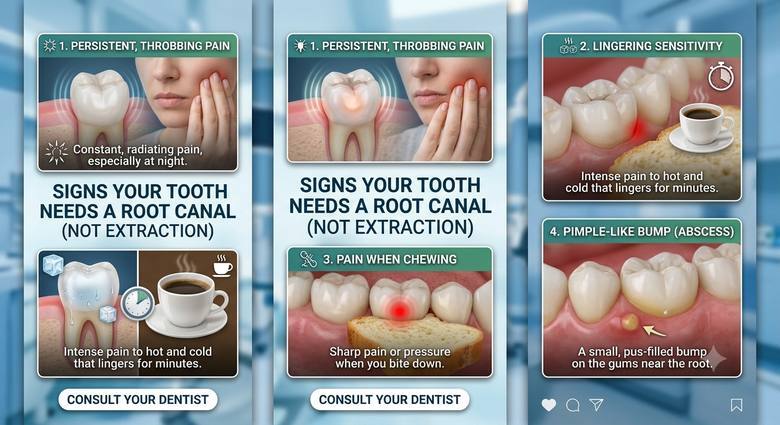
The four warning signs that usually mean root canal treatment, not extraction, is the right call.
If these symptoms sound familiar, don’t panic. With microscopic root canal therapy, we use a surgical operating microscope to see the internal canal anatomy with far greater precision than the naked eye allows. This means the infected tissue is removed more thoroughly, healthy tooth structure is preserved wherever possible, and the procedure itself is efficient and virtually pain-free under local anaesthesia.
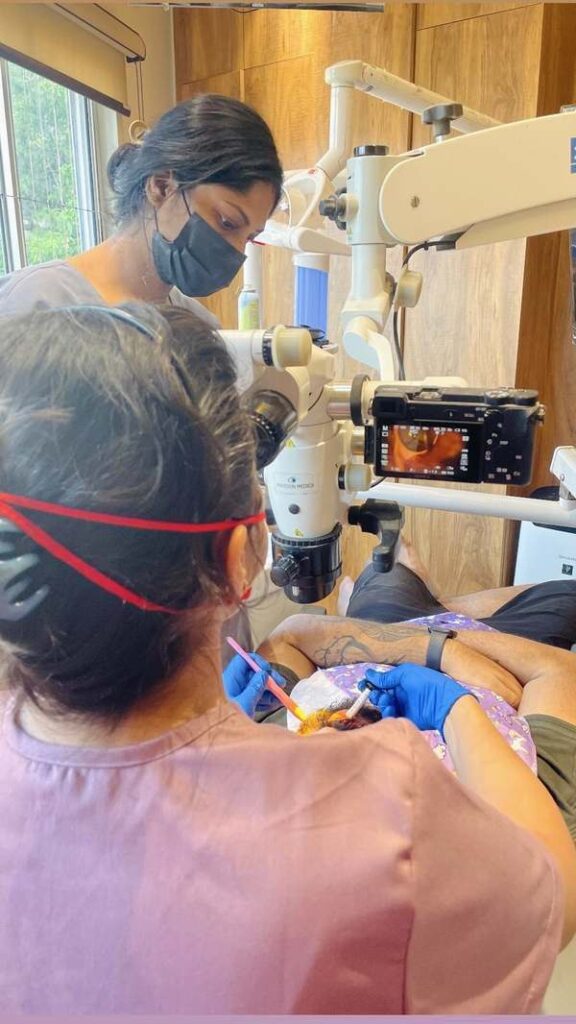
Microscope-assisted root canal treatment in progress, with live magnified imaging for precise, thorough cleaning of the canal. Photo used with patient consent.
When Is a Tooth Extraction Unavoidable?
We fight to save every tooth we can — but there are situations where the tooth itself is too compromised to be a safe long-term option, no matter how skilled the root canal technique. Recommending extraction in these cases isn’t giving up on the tooth; it’s protecting the rest of your mouth from a bigger problem.
Scenarios where extraction becomes necessary:
- Deep fractures or cracks that extend below the bone level, leaving no stable structure to seal or restore
- Severe, widespread tooth decay that has destroyed too much healthy structure to support a crown afterward
- Advanced periodontal (gum) disease that has caused significant bone loss around the tooth, making it loose or unstable
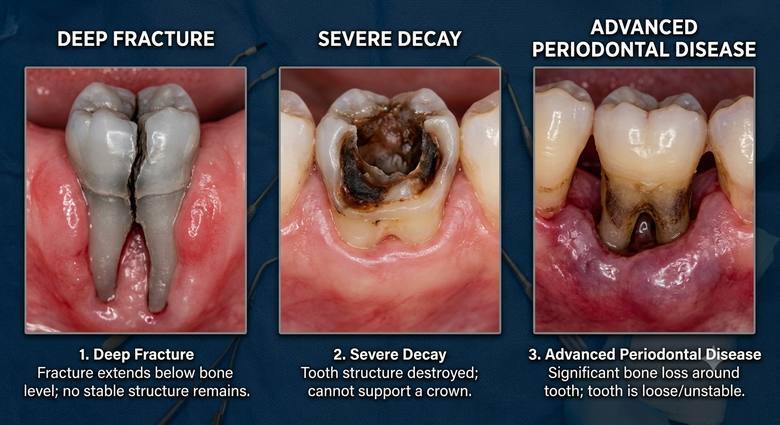
The three clinical scenarios that make tooth extraction necessary. Clinical images used with patient consent.
If extraction is genuinely the safest path forward, a modern, painless tooth extraction ensures the procedure itself is calm and comfortable, with proper anaesthesia and gentle technique. And extraction is never the end of the story — missing teeth can later be replaced seamlessly with dental implants, bridges, or partial dentures, restoring both function and appearance.
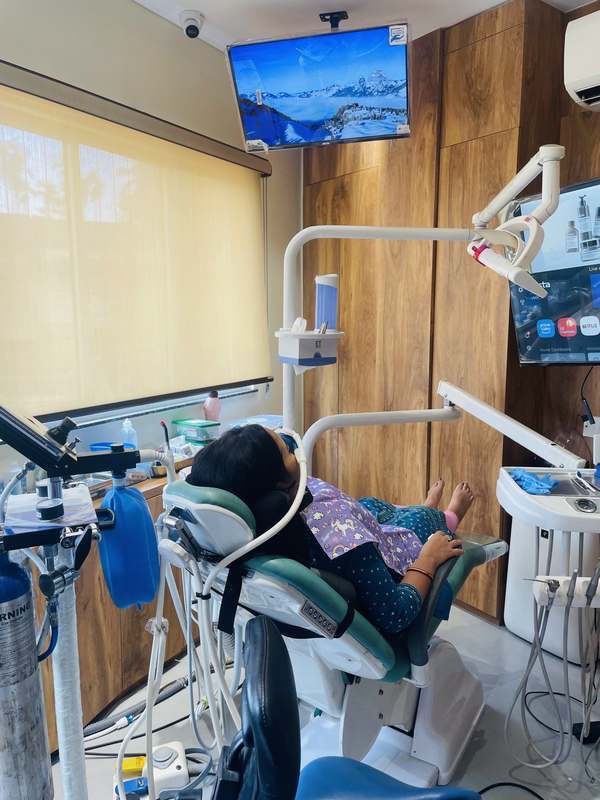
A relaxed patient during treatment at Smilestone Dental Care — comfortable seating with an overhead screen to ease the experience. Photo used with patient consent.
The Golden Rule: Saving a Natural Tooth vs. Replacing It
As an endodontist in Rajarhat, the question I hear most often is: “Why not just pull it and be done with it?” Here’s why saving a natural tooth through root canal treatment is usually the better long-term choice, unless the tooth is truly beyond repair:
| Factor | Root Canal Treatment | Tooth Extraction + Replacement |
|---|---|---|
| Jawbone health | Preserved — the natural tooth root keeps stimulating the bone | Bone can gradually shrink at the extraction site without a replacement |
| Chewing function | Fully restored, feels like your own tooth | Restored only after implant/bridge placement (additional time and healing) |
| Overall cost & time | Generally lower long-term, single-stage treatment | Higher long-term cost once extraction + implant/bridge are both factored in |
| When it’s the better option | When the tooth structure and supporting bone are still sound | When the tooth is fractured below the bone, non-restorable, or periodontally hopeless |
Conclusion: Let an Expert Make the Final Call
Here’s the honest truth: no article, including this one, can tell you with certainty whether your tooth needs a root canal treatment or an extraction. Only a digital X-ray combined with a clinical examination by an experienced endodontist can make that call safely. Symptoms can overlap, and self-diagnosis is where most delayed or wrong treatment decisions begin.
If you’re a resident of New Town, Rajarhat, or nearby areas like City Centre 2 and Chinar Park, and you’re dealing with tooth pain right now, don’t wait for it to get worse. Smilestone Dental Care, the trusted best dental clinic in New Town Rajarhat, offers a thorough evaluation to tell you exactly what your tooth needs — and why. If you’ve been searching “dentists near me” or “dental clinic near me,” you’ll find our team just minutes from City Centre 2 and the New Town metro corridor.
To book a consultation at Smilestone Dental Care, New Town Kolkata, call us or fill in the form below.
Schedule your dental evaluation with Dr. Aparna Gupta today
Watch: Inside a Root Canal Treatment at SmilestoneSee the procedure up close on our Instagram Reel
Frequently Asked Questions
Not always. If the pain is due to infected pulp but the tooth structure and supporting bone are intact, root canal treatment can usually save it. However, if the tooth has a deep fracture below the gum line or the surrounding bone has been badly damaged by infection, extraction may be the only safe option.
With modern local anaesthesia and technique, both procedures are designed to be comfortable during treatment. Many patients report that a painless tooth extraction feels quicker than expected, while microscopic root canal therapy is virtually pain-free due to precise, minimally invasive instrumentation.
Delaying treatment allows infection to spread further into the bone, which can turn a tooth that was once savable with a root canal into one that eventually requires extraction. It can also lead to facial swelling, bone loss, and more complex, costlier treatment later.
Missing teeth can be replaced with dental implants, bridges, or partial dentures, depending on your bone health, budget, and the location of the missing tooth. Dr. Aparna Gupta will discuss the most suitable option for you after the extraction site has healed.
Only a digital X-ray combined with a hands-on clinical examination by a qualified endodontist can confirm this. Self-diagnosis based on pain alone is unreliable, since both infected and severely damaged teeth can feel similar to the patient.
Smilestone Dental Care
New Town, Rajarhat, Kolkata — serving Action Area I, II, III, Chinar Park, and Biswa Bangla Gate.
Phone: +91 86979 69918
Hours: TUE – SAT: 10:00 AM – 6:00 PM, SUN: 10:00 AM – 1:00 PM
Google Maps: Get Directions