
By Dr. Aparna Gupta, Founder & Clinical Director.
If you’re choosing purely for the long haul, implants usually win. They can last 15 to 25 years or more and keep your jawbone from shrinking, where dentures don’t stop that shrinkage and tend to need relining or replacing every 3 to 5 years. But “usually” isn’t “always” — bone density, budget, and general health all factor in, which is why this is a conversation for your dentist, not a spreadsheet.
Most patients who ask us this question aren’t really asking about materials or procedures. They’re asking what their mouth is going to look and feel like ten, twenty, thirty years from now. That’s a harder question, and a fair one — a missing tooth today can quietly change your bite, your face shape, and what you’re comfortable eating, long after the gap itself stops bothering you.
We see this decision play out often at Smilestone Dental Care, a specialist dental clinic in New Town Kolkata that patients reach from across Rajarhat, Action Area I, II, and III. We don’t guess at bone health — every implant or denture case starts with digital X-rays and, where needed, a CBCT scan, so the recommendation is based on your actual jaw, not a general rule of thumb.
What are advanced dental implants?
An implant rebuilds a tooth in three parts: a titanium screw that takes over the job of the root, a small connector piece called an abutment, and a ceramic crown on top that does the visible work of biting and smiling. The titanium actually fuses with your jawbone — a process called osseointegration — which is the main reason advanced dental implants hold up so much like a real tooth.
They keep the bone active
A natural tooth root sends a steady signal to the jawbone every time you bite down, and that signal is what keeps the bone dense. Lose the tooth, and that signal stops — which is why people who go years without replacing a tooth sometimes notice their face looking subtly sunken near the gap. An implant root picks that signal back up.
Case Gallery — Bone Preservation
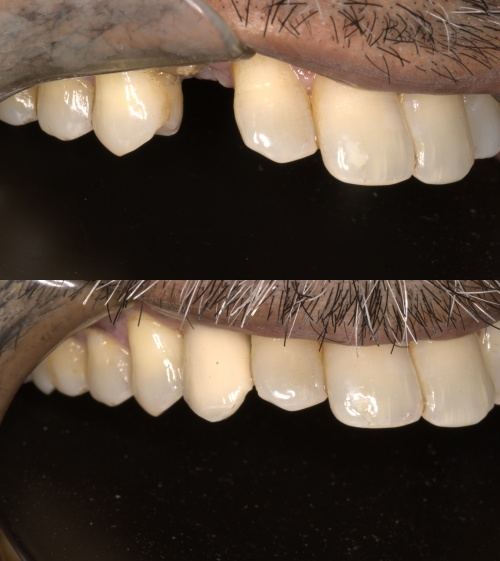
Actual patient case from our clinic, shared with consent.
They tend to last
With reasonable hygiene and regular check-ups, an implant can reasonably be expected to last 15 to 25 years, and often longer — though this varies with each person’s bone health and habits, so treat it as a range to discuss at your consultation rather than a promise.
Case Gallery — Long-Term Result
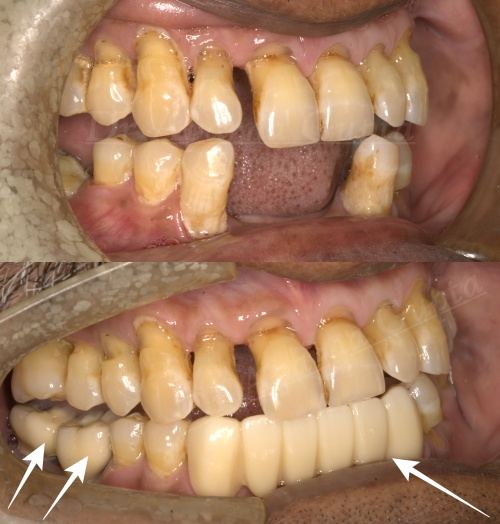
Actual patient case from our clinic, shared with consent.
They tend to last
With reasonable hygiene and regular check-ups, an implant can reasonably be expected to last 15 to 25 years, and often longer — though this varies with each person’s bone health and habits, so treat it as a range to discuss at your consultation rather than a promise.
Case Gallery — Long-Term Result
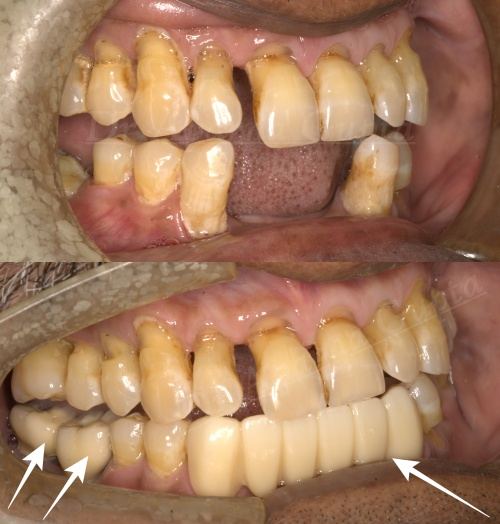
Actual patient case from our clinic, shared with consent.
They restore real chewing power
Implants bring back close to full natural bite force. Patients tend to notice this less as a dental detail and more as “I can eat what I want again” — which, over a few decades, matters more for nutrition and long-term oral health than most people expect going in.
Case Gallery — Restored Smile
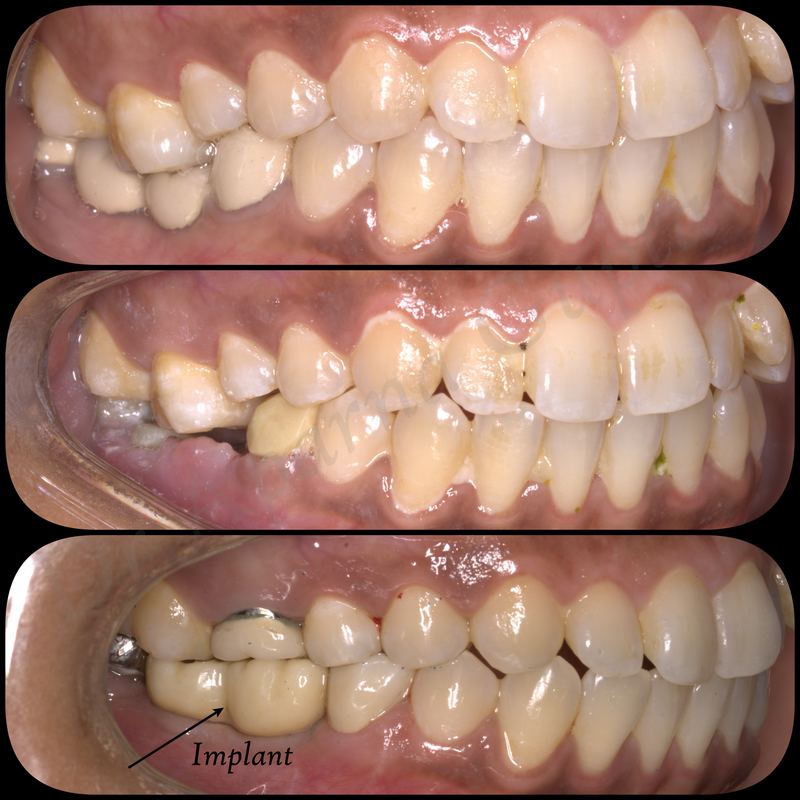
Actual patient case from our clinic, shared with consent.
What are custom-designed dentures?
Custom-designed dentures are removable prosthetics that sit on the gums instead of anchoring into bone. For a lot of patients they’re still the right call, especially as an initial or lower-cost option — but it’s worth being honest about how they behave over time, not just how they look on day one.
The bone keeps changing underneath them
Because a denture rests on the gum rather than stimulating the bone below it, that bone keeps gradually shrinking, much as it would if the tooth were simply left missing.
They need upkeep
As the jaw reshapes, a denture that fit comfortably in year one can start to feel loose by year three. Most patients end up needing a reline, an adjustment, or a full remake roughly every 3 to 5 years — again, an average rather than a fixed rule, since it depends on the individual.
Chewing takes a hit
Dentures typically restore only a fraction of natural bite force. Over years, that’s often what nudges long-term denture wearers toward softer foods — a quiet, gradual shift that’s easy to miss until you add it up over a decade.
Case Gallery — Dentures
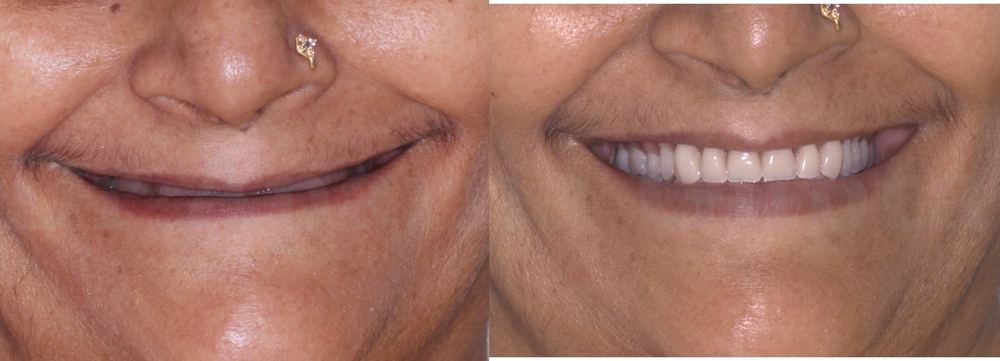
Denture case 1
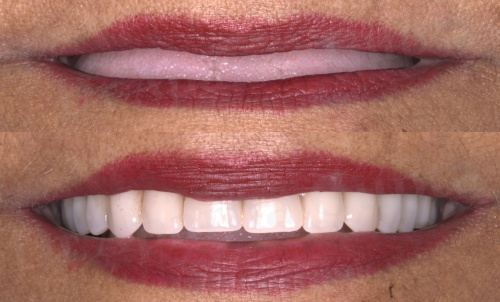
Denture case 2
Actual patient cases from our clinic, shared with consent.
The middle ground: implant-supported dentures
For patients missing every tooth in an arch, there’s a middle path worth knowing about. A handful of implants get placed to anchor a full-arch denture, so you get the stability of implants without the cost of replacing every tooth individually. The denture stops slipping while you talk or eat, and because it’s anchored to the implants rather than just resting on the gum, it slows the bone loss a conventional denture wouldn’t.
Implants vs. dentures, side by side
| Factor | Dental implants | Traditional dentures |
|---|---|---|
| Durability | 15–25+ years, often a lifetime | Typically 3–5 years before adjustment or replacement |
| Jawbone health | Stimulates bone, slows shrinkage | No stimulation; shrinkage continues |
| Daily care | Brush and floss like natural teeth | Removed daily for cleaning and soaking |
| Chewing power | Close to natural strength | Reduced; may limit food choices |
| Cost over time | Higher upfront, often cheaper over decades | Lower upfront, recurring costs add up |
“Patients rarely regret spending more upfront on an implant. What I do see them regret is putting off the decision for five years and losing bone in the meantime.”
— Dr. Aparna Gupta, Founder, Smilestone Dental Care
So, which should you choose?
Dentures are still a fair, budget-conscious starting point for some patients — particularly when cost or a health condition rules out surgery for now. But if the question is genuinely about long-term oral health, keeping your jawbone intact, and day-to-day quality of life, advanced dental implants — or implant-supported dentures for a full arch — tend to hold up better over the years that actually matter.
The only way to know for certain which is right for your mouth is a clinical exam and a CBCT scan to see your bone density for yourself. That’s usually a shorter appointment than people expect.
To book a consultation at Smilestone Dental Care, New Town Kolkata, call us or fill in the form below.
Frequently asked questions
For most patients, yes. Implants preserve the jawbone and can last 15 to 25 years or longer, while traditional dentures don’t stop bone loss and usually need replacing or relining every 3 to 5 years. A clinical exam and CBCT scan at Smilestone Dental Care can confirm which option suits your bone density.
Dentures rest on the gums rather than the jawbone, so they don’t stimulate bone the way a natural tooth root does. As the jawbone gradually reshapes, the denture stops fitting snugly — which is why relining, adjusting, or replacing them every 3 to 5 years is typically needed.
Implant-supported dentures anchor a full-arch denture onto a small number of dental implants. This combines the stability and bone-preserving benefit of implants with the full-arch coverage of a denture, so the appliance no longer slips or clicks while speaking or eating.
It depends how much bone remains. Some patients need a bone graft before implant placement, while others are still good candidates without one. A CBCT scan at Smilestone Dental Care, New Town Kolkata, is the only reliable way to assess this before treatment planning.
Implant placement is done under local anaesthesia, and most patients describe it as comfortable rather than painful, with mild soreness for a few days afterward that responds well to standard pain relief.
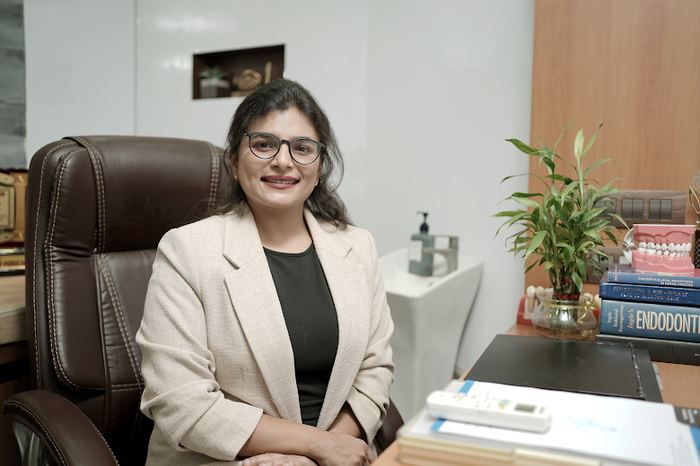 Founder & Clinical Director, Smilestone Dental Care
Treatment planning here is guided by Dr. Aparna Gupta, with implant and denture procedures carried out by our clinical specialists as part of one coordinated plan for each patient — from the first scan to the final fitting.
— The Smilestone team
- Digital X-rays and CBCT imaging to check bone density before recommending anything
- Written cost estimates upfront, before treatment starts
- Clinical photos shown on-screen so you can see your own case, not a stock diagram
- Staff who help elderly patients get to and from appointments
- Minutes from City Centre 2 and the New Town metro corridor, easy to reach from Action Area I, II, and III
Smilestone Dental Care, New Town, Rajarhat, Kolkata · Phone: +91 86979 69918 · Hours: MON: CLOSED,
TUE – SAT: 10:00 AM – 6:00 PM, SUN: 10:00 AM – 1:00 PM · Get directions on Google Maps